The site has a game, "AI or human?": eight paragraphs, half from classic authors and half from Claude, and you guess who wrote each. Playing it myself, I noticed something odd. On the human paragraphs I stumbled and reread the sentence. Text written by a neural network slid past without effort. So ease of reading seemed to be the answer to the AI vs human writing question. I decided to check this with numbers rather than a feeling, and to find out where the stumble comes from: old words, syntax, or something else.
What I compared#
From ru.wikisource I took 174 paragraphs of Russian prose, 40–75 words long, by Chekhov, Tolstoy, Bunin, Kuprin, Turgenev and Teffi. A separate Claude agent that had not seen these paragraphs wrote 30 of its own, with the brief "in the manner of the late 19th-century classics". The brief was deliberately hard: anyone can tell ordinary AI text from Chekhov, and I wanted to see what is left when the model is trying.
A script did the counting: sentence length, commas, word repeats inside a paragraph, and the share of rare words. I called a word rare if it occurs fewer than three times per million words in the frequency dictionary of the Russian National Corpus (Lyashevskaya and Sharov, 2009).
AI vs human writing: what the measurement showed#
| What I counted | Classics | Claude "in the manner of the classics" |
|---|---|---|
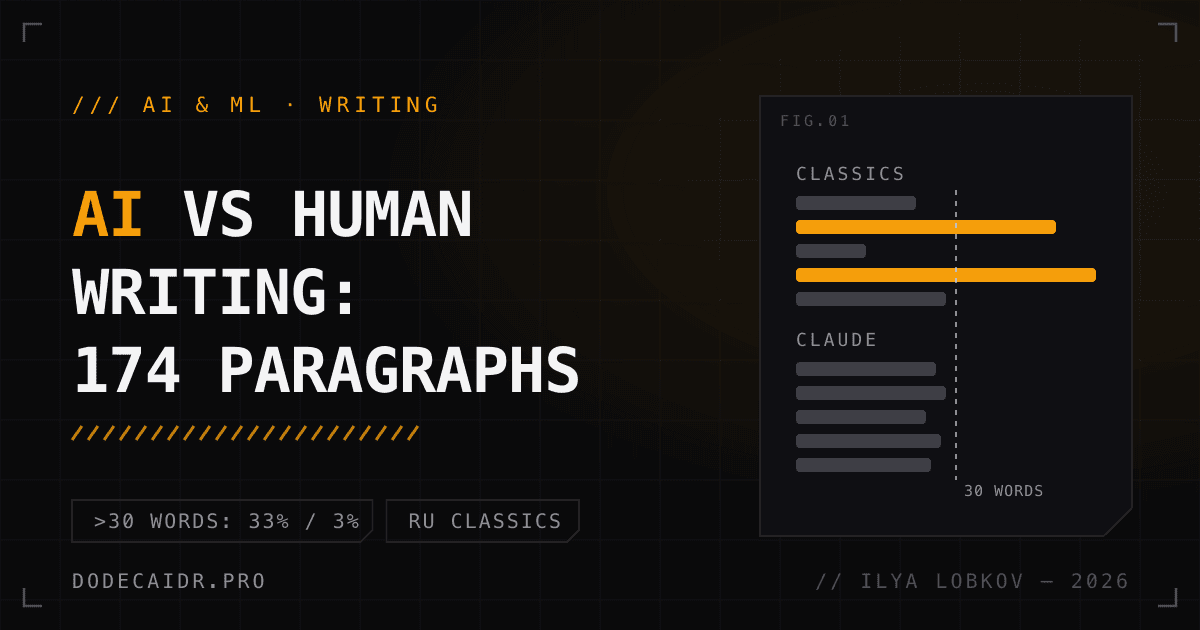
| Paragraphs with a sentence longer than 30 words | 33% | 3% |
| Average sentence length, words | 18.4 | 14.7 |
| Commas per sentence | 2.6 | 1.9 |
| Paragraphs where one content word is repeated | 49% | 33% |
| Share of rare words | 8% | 7% |
| Verbs among rare words | 25% | 18% |
The biggest gap is in the first row. A long sentence appears in every third paragraph of the classics and almost nowhere in Claude's text. On rare words the two nearly match, and that surprised me most: I had expected outdated words to cause the stumble.
The long sentence: where the reader stumbles#
Here is one paragraph from the sample, from Anna Karenina, the mowing scene. Both quotes in this article are my own translations from Russian.
The old man, holding himself straight, walked ahead, moving his turned-out feet evenly and broadly, and with a precise and even motion that seemed to cost him no more effort than swinging his arms as he walked, as if at play, laid down a uniform, high row. As if it were not he but the sharp scythe alone that swished through the juicy grass.
The first sentence is 34 words long in the Russian original. The verb «откладывал» ("laid down") comes almost at the very end, and until it arrives the reader holds the old man, his feet, the motion and the comparison with swinging arms in mind. Now a Claude paragraph on the same scene:
Mowing began on St. Peter's Day, as soon as the dew was off. The men walked side by side, swinging their scythes broad and even, and the grass lay down behind them in heavy, damp swaths. Women in red kerchiefs turned yesterday's hay with rakes. By noon it had turned stuffy, grasshoppers rang over the meadow, and everyone went down to the river, where under a willow stood a jug of kvass, covered with a burdock leaf.
Every sentence ends before the reader has time to forget anything. There is no sentence to reread.
This difference has a mechanism. Reading time for a word grows with the logarithm of how unexpected the word is: Smith and Levy showed this in 2013, and in 2024 it was confirmed on a large dataset in PNAS. A model, when generating, picks words from the most probable part of the distribution: that is how nucleus sampling and similar methods for cutting off unlikely words work. So AI text is made of expected words by the way it is produced, and it reads easily for that reason. In 1917 Shklovsky named the opposite «impeded form»: literature deliberately gets in the way of reading on autopilot.
Repeating a word instead of using a synonym#
In that same Tolstoy sentence the old man walks «ровно» ("evenly") and mows with a «ровным» ("even") motion. The writer repeats the word because the subject is the same. A precise repeat of a content word appears in 49% of classic paragraphs and in 33% of Claude's.
The model avoids the repeat and substitutes a synonym: after "garden" it will write, say, "estate", and after "old man" it will write "mower". As early as 1906 Fowler called this habit elegant variation and considered it a mark of bad style: the reader starts to wonder whether the text is about different things.
Old words barely matter#
Outdated marker words such as «давеча» ("the other day") or «покамест» ("for the time being") appeared in only about 12% of the classic paragraphs. They are not what causes the stumble.
Claude's share of rare words "in the manner of the classics" is almost the same as the classics', 7% against 8%. What differs is which words they are. In Claude's text they are period props: курсистка (a woman student at the higher courses), жбан (a large jug), косоворотка (a peasant shirt fastened at the side), гувернантка (a governess), маменька (an old-fashioned "mama"), дьячок (a parish clerk). Such words put scenery on a stage. Among the classics' rare words there are more verbs of concrete action. On that same meadow Tolstoy's peasants «развязывали мешочки с хлебом и оттыкали кувшинчики с квасом» ("untied the little bags of bread and unstopped the little jugs of kvass"), and the scythe «вжикала» (a sound-word, roughly "swished"). The scene needs these words: without them you cannot see what the hands are doing.
For comparison, in the first version of the game the AI fragments were written without the "in the manner of the classics" brief, and rare words made up about 2% of them. Players spotted them by smoothness alone.
Why the model writes this way: what the research says#
- Imitating a style does not make text unpredictable. In a 2025 study models copied the style of a specific essay author quite well, but the perplexity of their text was 15.2 against 29.5 for humans. It sounds similar, yet the perplexity is almost half as high: the words are more predictable.
- Instruction-tuned models are further from humans than base models. On Biber's features (grammar and rhetoric), the gap from human text is larger for models tuned to follow instructions than for the original ones.
- Post-training smooths prose. Across four versions of one OLMo model, you can see the spread of topics, emotions and style narrowing after each stage of tuning. Professional literature compresses the most.
- Period examples in the prompt do not produce period style. If you show a model samples of old prose, it still writes like a modern author, and people notice.
- People guess badly. In a 2023 PNAS experiment readers told human and AI texts about themselves apart at the level of a coin flip: they relied on signs of AI writing that do not work.
How I built the game so players don't guess from small things#
After the measurement I expanded the game to 52 human and 52 AI fragments in each of the site's five languages. Part of the new AI fragments Claude wrote with the numbers above in mind: with a long sentence, a precise repeat and rare verbs instead of props.
Along the way some clues came up that have nothing to do with style:
- Length. The first AI drafts were longer: a median of 65 words against 55 for humans in the English version, 53 against 46 in the Russian one. A player would have guessed from paragraph length. After the edit the medians in the Russian, English and Spanish versions differ by no more than 3 words.
- Identical openers. Three Russian AI fragments began with «Письмо от» ("A letter from"), and five Spanish ones with «En la». I rewrote them.
- Exotica. Among the humans there are now old translations: Gogol translated by Lu Xun, Chekhov translated by Constance Garnett. If the AI wrote only about the Russian countryside, a Japanese temple would give the human away. So about a tenth of the AI fragments are written as an old translation.
- The letter «ё». In the Russian version of the game it is absent from the human fragments, which use «е» everywhere, so the AI fragments must not have it either.
Each of the 200 new human fragments was checked against its source word for word by a script: it downloaded the page from an open library, normalized the spelling, and found the whole fragment in it, down to the last comma. No mismatches remain.
What this measurement does not say#
- The AI sample is small: 30 paragraphs from one model on one brief. The numbers show a direction; you cannot derive a detector threshold from them.
- Words were compared by a crude stem, without a lemmatizer, so the share of rare words is approximate.
- Everything was counted on Russian prose. I did not run this measurement for the game's other languages.
- How can you tell if a text is AI generated from a single paragraph? Reliably, you can't: both people and detectors get it wrong. A long sentence and a repeat say "more likely human", but a good writer can be smooth, and an AI can be made to write roughly.
- Friction belongs to literary prose. In a technical article a long sentence "for liveliness" gives nothing: what makes such a text human is specific versions, errors and numbers, and that same repeat of a term instead of synonyms.
Try it yourself. The game "AI or human?" has eight rounds, and after each you see the author or the sign that gave the AI away. How I measured language models on my own set in a different task is covered in the article on AI code review on 30 real bugs.


