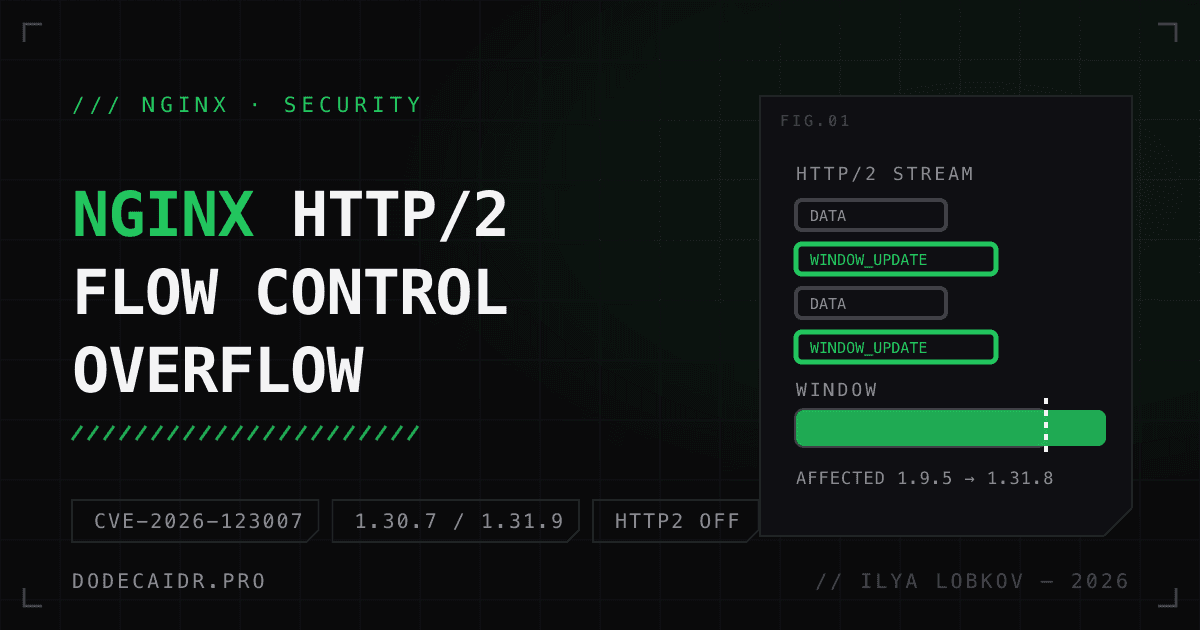
On November 18, nginx 1.30.7 and 1.31.9 shipped with fixes for ten vulnerabilities. Two of them sit in the HTTP/2 module, and according to researchers, both allow code execution on the server without authentication. The nginx HTTP/2 vulnerability CVE-2026-123007 has been in the code since version 1.9.5, released on September 22, 2015: 11 years. CVE-2026-123633 arrived in 1.19.7 on February 16, 2021, so it is almost six years old.
A line is going around social media that up to 225 million sites are at risk. The number is real, but it means something else: that is how many sites run nginx according to Netcraft's September survey, as cited by Wiz. Censys counted about 8.8 million services on November 19 that are potentially exposed to CVE-2026-123007 by version and enabled HTTP/2. That is also an estimate from the version number, without checking the config, and it is still 25 times smaller. Below: what the bugs are, how to check your server in a couple of minutes, and what to do if you cannot update today.
nginx HTTP/2 vulnerability: two bugs, different conditions#
| CVE-2026-123007 | CVE-2026-123633 | |
|---|---|---|
| What is broken | Flow control window overflow in HTTP/2, write past the end of a buffer | Use-after-free in HTTP/2 when worker_connections runs short |
| Affected | 1.9.5 to 1.31.8 | 1.19.7 to 1.31.8 |
| When it triggers | HTTP/2 over TLS is enabled. Wiz demonstrated code execution on an nginx that simply serves static files | HTTP/2 is enabled, nginx proxies requests to a backend, and the worker runs out of free connections |
| nginx.org rating | major | medium |
| F5 rating | CVSS 4.0: 9.2 | CVSS 4.0: 9.2 |
| Public exploit | Proof of concept from Rapid7 | Wiz does not publish its own |
| Fixed in | 1.30.7 stable, 1.31.9 mainline | 1.30.7 stable, 1.31.9 mainline |
The sources disagree about ASLR. F5 is cautious: code execution is possible if ASLR is disabled or the attacker can bypass it. Wiz answers that it can: both bugs let an attacker read memory first, and the researchers bypassed ASLR on the official 1.31.7 and 1.31.8 builds. The code runs with the privileges of the nginx worker process, not root.
An attack on CVE-2026-123007 is noisy. According to Upwind's analysis, crashing a worker takes about 60 GB of traffic over a single connection, and code execution takes about 128 GB. That gives you a signal for monitoring: long-lived HTTP/2 connections with a huge volume of data and many WINDOW_UPDATE frames. At the time of publication nobody had recorded attacks in the wild, and these CVEs are not in the CISA KEV catalog.
Does this affect me? Three checks#
1. Is HTTP/2 enabled. Without it neither bug is reachable. nginx does not enable HTTP/2 by itself, the config does: the http2 on; directive (since 1.25.1) or the http2 parameter in listen.
nginx -T 2>/dev/null | grep -nE 'http2|listen .*443'2. Which version you actually run. nginx -v tells the truth only for builds from nginx.org and the official Docker images. Distributions backport fixes into their old version, and the number does not change. For example, in Ubuntu 24.04 the fixed package is called 1.24.0-2ubuntu7.20, and nginx -v still shows 1.24.0. Look at the full package version and compare it with your distribution's advisory:
dpkg -l nginx | tail -1          # Debian, Ubuntu
rpm -q nginx # RHEL, Fedora, Alma| Distribution | Fixed package | Advisory |
|---|---|---|
| Ubuntu 24.04 LTS | 1.24.0-2ubuntu7.20 | USN-9159-1 |
| Ubuntu 22.04 LTS | 1.18.0-6ubuntu14.23 | USN-9159-1 |
| Ubuntu 26.04 LTS | 1.28.3-2ubuntu1.13 | USN-9159-1 |
| Debian 13 trixie | 1.26.3-3+deb13u11 | DSA-6642-1 |
| Debian 12 bookworm | 1.22.1-9+deb12u11 | DLA-4918-1 |
3. Whether nginx is hiding inside something else. A Docker image based on nginx, an ingress controller in Kubernetes, a hosting panel, a load balancer. In a container, check the version in the image itself, not on the host: docker run --rm <image> nginx -v.
How to update nginx: reload will not help#
A new binary is picked up only by a restart. nginx -s reload rereads the config, but the master process stays the old one, along with the old HTTP/2 code.
sudo apt update && sudo apt install --only-upgrade nginx   # update nginx on Ubuntu/Debian
sudo systemctl restart nginx
If downtime is not acceptable, there is a live binary swap using the USR2 signal and QUIT to the old master. It is described in the nginx documentation under "Upgrading Executable on the Fly".
The official images on Docker Hub are already updated: the 1.31.9 and mainline tags came out on November 19, 1.30.7 and stable on November 20. If an image is pinned by digest or was built earlier, you need to rebuild and redeploy it. An nginx:stable tag pulled a month ago is still the old one.
Can't update today: disable HTTP/2 in nginx#
The temporary measure closes both HTTP/2 bugs, and a plain reload is enough for it, because only the config changes.
server {
    listen 443 ssl;        # was: listen 443 ssl http2;
    http2 off;             # nginx 1.25.1 and newer
    # ...
}
Before 1.25.1 there is no http2 directive, so removing http2 from listen is enough. Check every server block on that port. The http2 parameter in listen applies to the whole address and port at once, so one forgotten block leaves HTTP/2 enabled for every site on it.
The price: clients fall back to HTTP/1.1, and pages with many resources load more slowly. A gRPC frontend cannot be saved this way, because grpc_pass does not work without HTTP/2, and updating is the only option there. Turn HTTP/2 back on after the update.
Ingress-nginx in Kubernetes#
This is the worst case. The community project kubernetes/ingress-nginx is archived, ships nginx 1.27.1, has HTTP/2 on by default, and will get no fixes in any release. The Rancher and Chainguard forks were also unfixed at the time of Upwind's analysis.
What to do now: set use-http2: "false" in the controller ConfigMap and plan a migration. For F5 NGINX Ingress Controller the fixed version is 5.8.0 (HTTP/2 is off by default there), and for NGINX Gateway Fabric it is 2.9.0, but HTTP/2 is on by default there.
What else the same release fixed#
1.30.7 and 1.31.9 fix ten CVEs. A set of five bugs that allow code execution was named nginx2root by the researchers. Disabling HTTP/2 closes only two of them. The other three need their own conditions:
- CVE-2026-121810: use-after-free in HTTP/3. Temporary measure: remove
quicfromlisten, sethttp3 off;, and sendAlt-Svc 'clear'. - CVE-2026-123634: use-after-free in
resolverwhen one name is resolved concurrently in subrequests (proxy_passwith a variable andmirror, SSI). - CVE-2026-113425: use-after-free in the mail proxy. If you run one, restrict access to it by IP.
The name nginx2root comes from this: Xint chained CVE-2026-123007 with a bug in the Linux kernel SCTP module and got root on the host, including from inside a container. Updating nginx does not fix the kernel. If you do not need SCTP, block the module from loading with the line install sctp /bin/false in /etc/modprobe.d/. It will not unload a module that is already loaded: unload it with rmmod sctp or reboot the server.
What I run#
I keep seven Next.js sites in Docker on one server through Dokploy, with Traefik taking the incoming traffic. Today I ran grep over all seven Dockerfiles and configs: there is no nginx anywhere, and the base images are only node. So this release does not affect me, unlike October's, when I had to fix six of the seven sites. I covered that case in the article on the Next.js vulnerability of October 2026.
If you have nginx, the order is this: check whether HTTP/2 is enabled. If it is, update the package or image today, and set http2 off until the rollout. The previous batch of bugs came out a month earlier, in 1.30.6 and 1.31.7. It is covered in the roundup of nginx and other October CVEs: the conditions there are different, tied to alias, map and aio.
Sources: nginx.org advisories, nginx CHANGES, Wiz analysis, Upwind on Kubernetes, Equixly on disabling HTTP/2, Ubuntu CVE-2026-123007, Debian security tracker, BleepingComputer with Censys data.